The Great Galaxy in Andromeda: 100 Minutes on M31
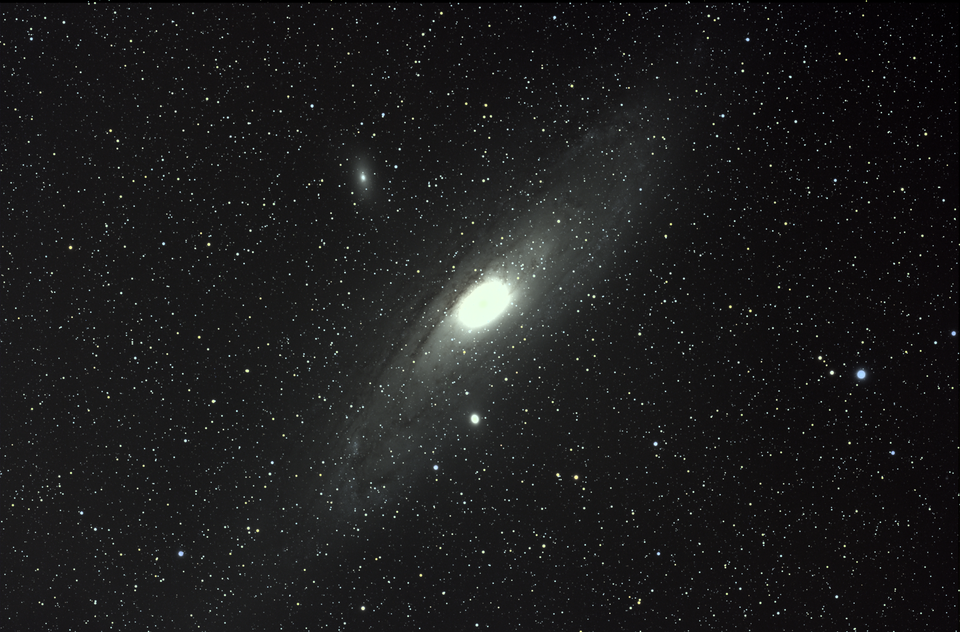
Some targets never get old. Messier 31—the Andromeda Galaxy—is probably the most photographed deep-sky object in the northern hemisphere, and for good reason. It's big, it's bright, and it's heading toward us at 110 kilometers per second. In about 4.5 billion years, it'll merge with the Milky Way. Until then, I'll keep imaging it.
The Session
This was one of those nights where everything just worked. The tracking was dialed in perfectly, and I managed to collect 20 exposures at 300 seconds each—a solid 100 minutes of total integration time. With the Askar FRA400 and ZWO ASI2600MC Pro, that's enough data to really dig into the dust lanes and satellite galaxies.
Five-minute subs at f/4.6 push the boundaries of what unguided tracking can handle, but the ASI AM5's harmonic drive kept the stars tight across the entire run. When the tracking behaves, you can feel it in the final stack—cleaner gradients, sharper detail, and far less wasted data.
Why M31 Still Surprises
At 2.5 million light-years away, Andromeda spans over 3 degrees of sky—six full moons lined up edge to edge. The FRA400's wide field captures the core, the sweeping dust lanes, and both satellite galaxies (M32 and M110) in a single frame. It's one of the few targets where a 400mm focal length feels almost too tight.
What strikes me every time I process M31 is the sheer amount of structure hiding in the disk. The dark dust lanes that thread through the spiral arms. The pink HII regions dotting the outer edges. The subtle color gradient from the yellowed core to the bluer star-forming regions. It's a trillion-star galaxy compressed into a few thousand pixels, and somehow each processing session reveals something I missed before.
Processing Notes
With 100 minutes of clean data, I had room to be aggressive with noise reduction while preserving fine detail. The key with M31 is managing the dynamic range—the core is blazingly bright compared to the faint outer arms. I used a combination of HDR techniques and careful masking to keep the core from blowing out while still pulling detail from the periphery.
The improved tracking showed up immediately in the star profiles. Round stars across the entire frame make calibration and stacking far more forgiving. It's a reminder that mount performance is the foundation everything else builds on.
M32 and M110: The Supporting Cast
One of the joys of imaging M31 is catching its companions. M32, the compact elliptical galaxy, sits close to Andromeda's disk and almost looks like an overexposed star at first glance. M110, the larger dwarf elliptical, floats above the main galaxy with its own subtle dust lanes—unusual for an elliptical.
These are gravitationally bound neighbors, slowly being consumed by their massive host. In a few billion years, they'll be fully absorbed. For now, they add depth and context to the frame.
Final Thoughts
100 minutes isn't a lot of integration time by deep-sky standards, but on a night with solid tracking and transparent skies, it's enough to produce a result I'm genuinely happy with. M31 rewards patience—there's always more detail hiding in the noise, waiting for the next clear night.
Clear skies.
Equipment: Askar FRA400 · ZWO ASI2600MC Pro · ASI AM5 Mount
Acquisition: 20 × 300s (1h 40m total integration)